
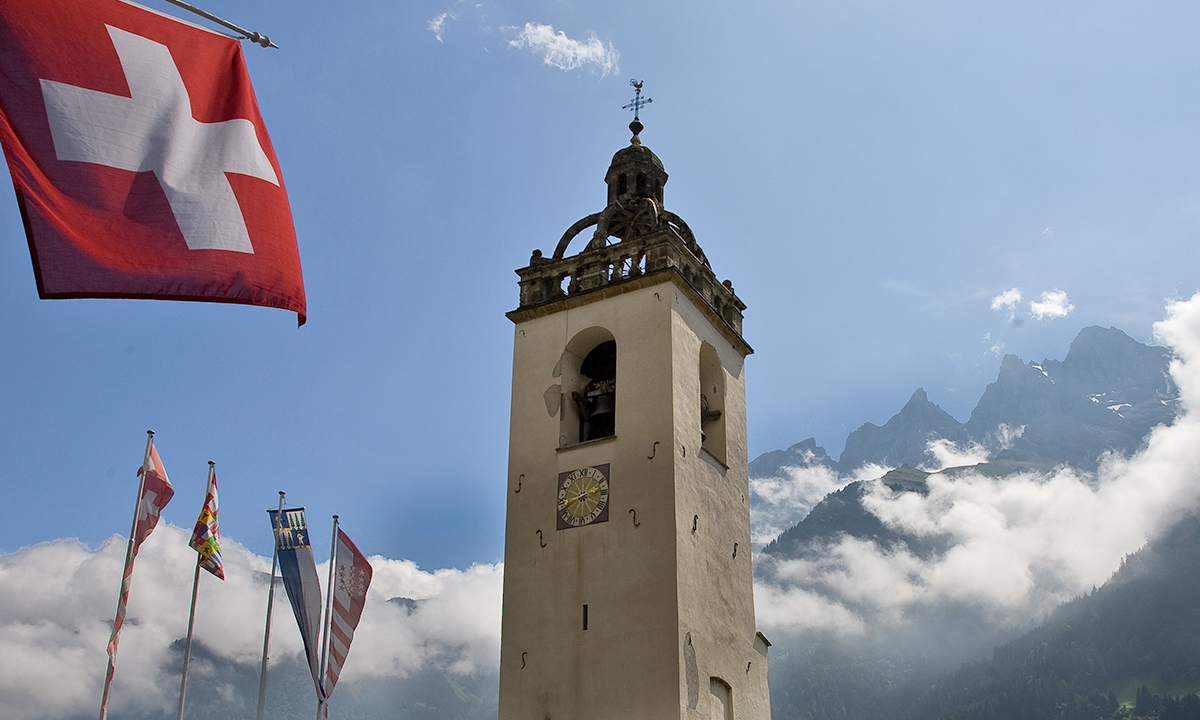
Discover the history, symbols and artistic works of Champéry's catholic church with a unique sound and light show. Once inside the church, simply press a button, then follow your eyes and ears as you are guided by lights and audio commentary.
In the centre of Champéry village, Saint Théodule Church is one of the resort’s most recognisable heritage landmarks.
A place of worship rooted in village history
Its history dates back to the 15th century, when a first chapel was built in 1436 and later dedicated to Saint Théodule. The choice of name is closely linked to Valais history: Saint Théodule is regarded as the first Bishop of Sion and remains one of the canton’s major religious figures. The church’s name therefore reflects Champéry’s connection with the spiritual history of the Diocese of Sion, which played an important role in the development of Valais parishes.
Over the centuries, the place of worship evolved alongside the village. Initially attached to the parish of Val-d’Illiez, Champéry gradually developed its own religious life, notably with the creation of a rectorate in the 18th century. A Baroque church was built around 1725, followed by several later transformations leading to the present-day church, consecrated in 1966.
A listed bell tower in the heart of Champéry
The church’s most striking feature is its arched bell tower topped with a lantern, preserved from the former 1725 church and listed as a historic monument in 1964. Its unusual silhouette, made up of four masonry arches supporting a lantern, stands apart from more traditional Alpine spires. Crown-like in shape, it gives the centre of Champéry a distinctive visual identity and is instantly recognisable from the village street.
Today, this bell tower is the main architectural reminder of the 18th-century Baroque church. Preserved through later reconstructions, it creates a direct link between the former sanctuary and the contemporary church. The building brings together two periods: the historic verticality of the stone bell tower and the more understated architecture of the present church, shaped by a modern approach to volume, light and wood.
A sober and light-filled contemporary interior
Inside, the present-day church has a clear, pared-back architectural style typical of the second half of the 20th century. Simple lines, readable volumes and natural materials create a calm atmosphere suited to reflection. This sobriety also draws attention to the religious artworks, liturgical symbols and the figure of Saint Théodule, represented in the choir.
Saint Théodule, a figure of Valais and the Diocese of Sion
The church is dedicated to Saint Théodule, the first Bishop of Sion and an important figure in Valais heritage. His name is closely tied to the canton’s religious identity: in local tradition, he represents the spiritual authority of the diocese, the protection of the territory and the early roots of Christianity in Valais.
The legend of the bishop Saint Theodule
A very long time ago, Theodule was the first bishop of Sion. One night he dreamed that the Pope was in danger. He woke with a start to hear wicked laughter coming from just outside his window. Leaning over the windowsill, he could just make out three devils dancing in the moonlight. A courageous man as well as holy, he called out to the devils and asked which one of them was the fastest. The first devil said he was as fast as the wind; the second devil replied replies that he was as fast as a cannonball; the third said that he could traverse the universe as fast as a woman’s thoughts.
Hearing this, Saint Theodule then promised the last devil his soul, if he would take him to Rome and back to before dawn. The devil eagerly agreed to the bargain, placing a black cockerel on the ramparts of the city of Sion. In turn, Saint Theodule placed a white cockerel on the roof of his castle, begging him not to fall asleep. In an instant, the devil whisks the bishop away to Rome, where he can warn the Pope of the danger that threatening him.
In grateful recognition, the Pope gives the bishop an enormous bell for his diocese. The devil must now carry Theodule and his bell back to Sion. With great difficulty, he manages to cross the mountain pass which we know today as the Theodule Pass, finally reaching the town square in Sion just before dawn.
According to the bargain he made with the bishop, he must still climb the steep hill to reach the castle, but it is too late. High on his perch atop the castle, the Episcopal cockerel spies the rising sun and crows, waking the devil’s sleeping black cockerel, who begins to crow at the top of his lungs as well. The bet is lost and the devil is furious.
A sound and light visit
Inside the church, a sound and light visit introduces visitors to the building’s history, symbols and artworks. Simply step inside, press a button, then follow the lights and audio commentary.
Highlights include:
- the listed 1725 bell tower, preserved from the former Baroque church;
- its rare arched silhouette topped with a lantern;
- the interior architecture of the present-day church, consecrated in 1966;
- the sound and light visit about the church’s history, symbols and artworks;
- the legend of Saint Théodule, with its bell, devil, white cockerel and Valais storytelling tradition.
Located on the village street, Saint Théodule Church is an accessible cultural stop for anyone interested in religious heritage, local history, sacred art and the popular legends of Valais.
Opening hours
Accessibility
- Accessible for self-propelled wheelchairs
- Reserved space 330 cm wide < 100 m from the site
The PRM parking space is located at the Broisin praking in the village center, 150m from the church.
Prestations
- Parking nearby
- Tour free of charge